
PMS in Pre-Adolescence? Understanding Your Daughter’s Mood Swings
Is your daughter more sensitive, irritated, or experiencing mood changes? Understand what happens during pre-adolescence, how hormones influence this stage, and why tracking these signs can help you both better understand her body and emotions.
Suddenly, she seems more sensitive. One day, she’s cheerful and full of energy. The next, a simple comment might make her cry or respond in a way you didn’t expect.
At times like these, it’s natural for many moms to wonder: Could this already be PMS in pre-adolescence, or is it simply part of growing up?
If you’re here looking for that answer, know that you’re not alone. Pre-adolescence is a stage full of discoveries, both for girls and for the people who love and support them.
The good news is that most of these changes are completely expected. Understanding what’s happening in your daughter’s body can ease anxiety and make this stage much smoother for the whole family.
Let’s explore what science knows about these changes and how you can support your daughter with confidence and care.
Does PMS Really Exist in Pre-Adolescence?
This is one of the most common questions families ask. After all, when we think about PMS, we usually picture someone who already has regular menstrual cycles.
The truth is that the body begins going through hormonal changes long before the menstrual cycle becomes regular.
During puberty, the hormones become more active, preparing the body for the first menstrual period.
During this stage, some girls may experience changes in mood, energy levels, and even in the way they respond to everyday situations.
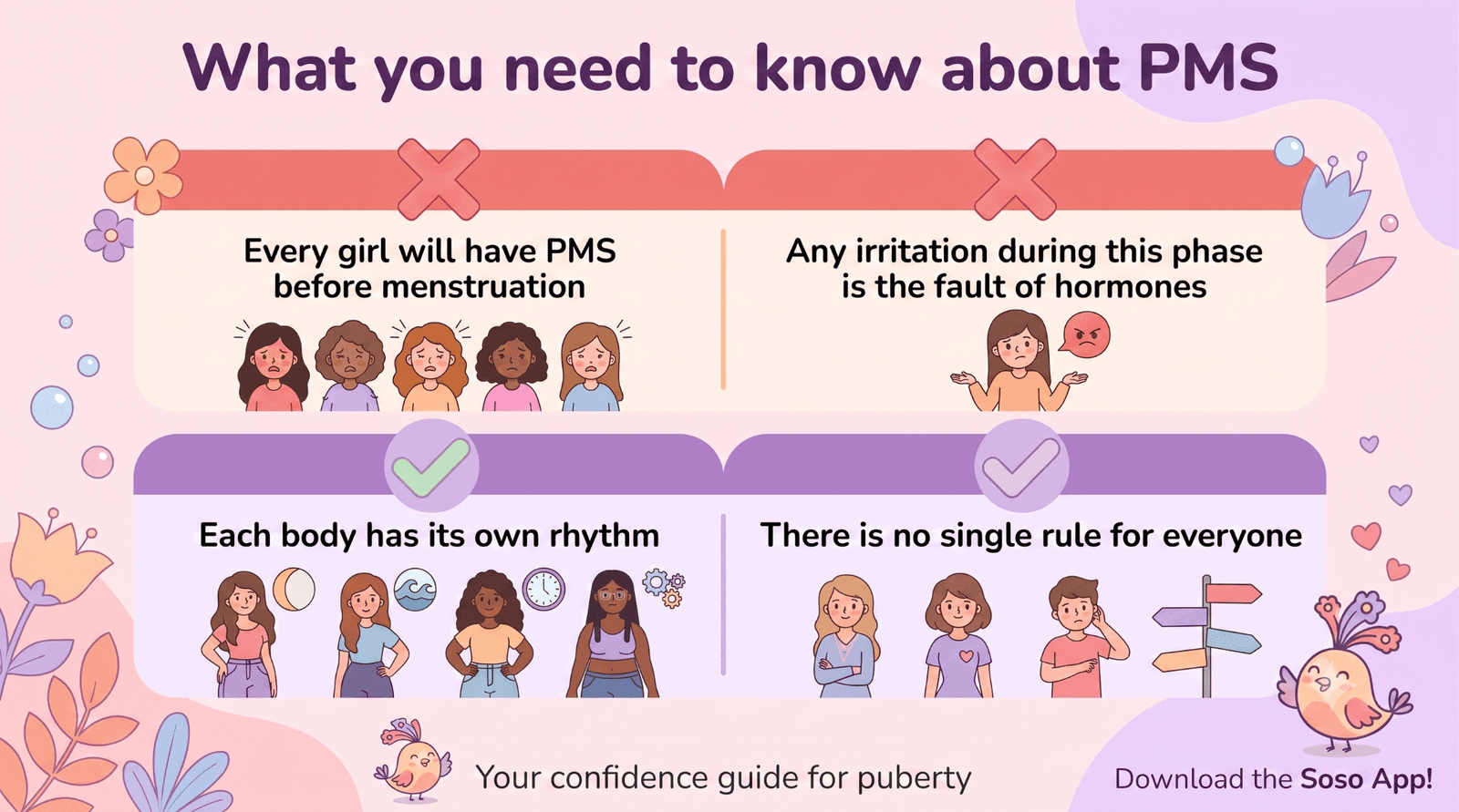
That doesn’t mean every girl experiences PMS before her first period. Nor does it mean every mood change is caused by hormones. The most important thing to remember is that every body develops at its own pace, and there’s no single pattern that applies to everyone.
How Hormones Begin Changing Before the First Period
Even before menarche—the medical term for a girl’s first menstrual period—the brain and ovaries begin working together to establish the menstrual cycle.
This process happens gradually and can take a few years to reach a more predictable pattern.
While this maturation process takes place, it is common for girls to experience emotional fluctuations. On some days, they may feel more energetic and cheerful. On others, they may need more time alone, show greater sensitivity, or become irritated more easily.
Think of this stage like learning a new skill. At first, everything feels a little uncoordinated. Over time, the body finds its rhythm, and these changes begin to make more sense.
Moms, Take Note: Not Every Mood Change Is PMS
It’s easy to assume that every behavioral change is caused by hormones. But your daughter’s life is changing in many other ways as well.
She is getting to know a changing body, making new friends, facing challenges at school, and beginning to build her own identity. All of these experiences also influence the way she feels.
Before assuming it’s all PMS, consider the bigger picture. A disagreement with a friend, an important test, or a period of insecurity can explain a mood change just as much as hormonal fluctuations.
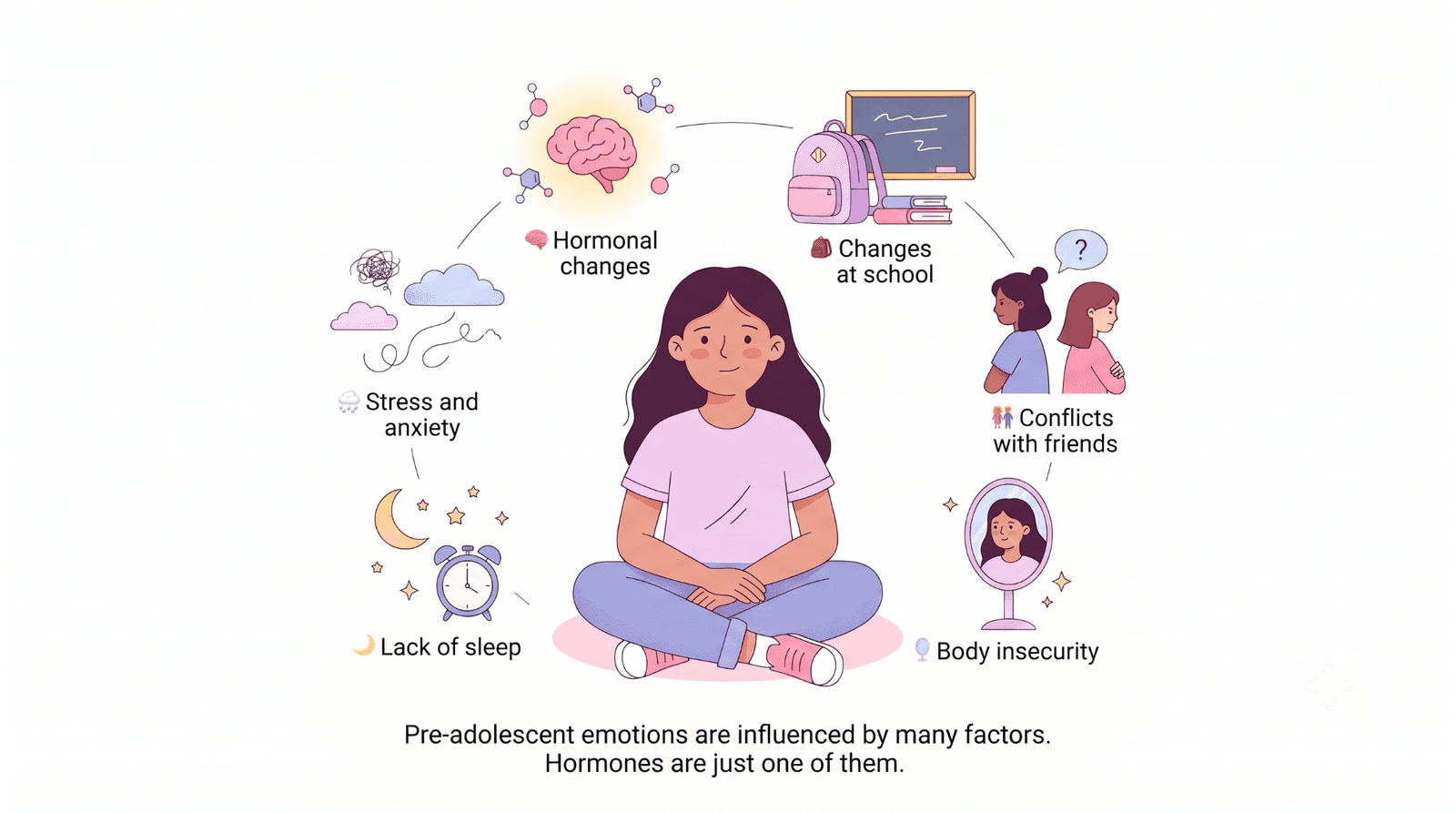
Looking at all these factors together is usually much more helpful than searching for a single explanation.
Notice how hormones are only one piece of the puzzle. Observing the whole picture is far more valuable than focusing on just one possible cause.
What Emotional Changes Are Normal During This Stage?
When we talk about pre-adolescence, there is no exact list of symptoms that all girls will experience.
What matters most is whether these changes are temporary and whether your daughter continues to enjoy school, play, spend time with family and friends, and participate in her daily activities.
Rather than trying to eliminate these emotions, think of them as an opportunity to better understand what your daughter is experiencing.
Some of the most common emotional changes include:
- Greater emotional sensitivity;
- Irritability for no apparent reason;
- A desire to spend more time alone at certain moments;
- Rapid mood changes;
- A greater need for support and reassurance;
- Insecurity about her own body;
- Feeling embarrassed about the changes that come with puberty.
But don’t worry. This does not mean that all of these situations will happen to your daughter, or that they will all appear at the same time. They simply show that each girl experiences this stage in her own unique way.
How Can You Tell the Difference Between PMS and Normal Puberty Changes?
Once you understand that mood swings are a natural part of growing up, another common question arises: How can you tell whether they’re related to PMS or simply to puberty?
The answer usually doesn’t come after just one day. The key is to observe what happens over time.
The body leaves clues, and when those clues begin repeating themselves, it becomes much easier to understand what’s going on.
That’s why healthcare professionals focus on a girl’s overall history rather than a single episode.
However, when these changes become very intense, persistent, or start affecting daily life, it is worth talking to a pediatrician or adolescent medicine specialist to better understand what is happening and receive appropriate guidance.
The more information you have about your daughter’s routine, emotions, and menstrual cycle, the easier it becomes to identify meaningful patterns.
It is important to remember that every girl experiences puberty in her own way. In most cases, mood changes are part of this development process and are related to changes in the body, hormones, and this stage of life itself.
Focus on Patterns, Not Individual Episodes
Imagine your daughter was especially irritable one month because she had an argument with a friend at school. The following month, she returned to her usual self.
In that situation, her mood change was probably much more related to what happened than to hormonal changes.
Now imagine another scenario.
Every month, a few days before her period, she becomes more sensitive, cries more easily, feels unusually tired, and then naturally improves once menstruation begins.
That’s a recurring pattern worth paying attention to.
%25201200x675%2520pixels%2520(9).png&w=3840&q=75)
It’s this consistency that helps healthcare professionals, parents, and girls themselves better understand how their bodies work.
Some helpful questions include:
- At what point in the month does her mood usually change?
- How long do these changes last?
- Do they occur alongside symptoms like cramps or breast tenderness?
- How does she feel once this phase passes?
These simple observations can make a significant difference and help prevent jumping to conclusions.
Tracking Emotions Helps You Understand the Menstrual Cycle
When we think about tracking a menstrual cycle, we often focus only on the dates when menstruation starts and ends.
But the body tells a much bigger story.
Emotions, energy levels, cramps, and mood changes can all reveal valuable patterns.
Many of these details go unnoticed because we rely on memory—and after a few weeks, remembering everything accurately can be difficult.
Keeping track of these changes turns small observations into meaningful information.
Over time, it becomes easier to recognize whether a particular emotion appears before menstruation or is related to something else happening in daily life.
Why Tracking Periods Alone Isn’t Enough
Imagine sitting in your pediatrician’s office and being asked how your daughter has been feeling over the past three months.
You’ll probably remember the biggest events, but will you remember every important detail?
Those small details often provide the most valuable insights.
When your daughter records how she feels throughout each phase of her cycle, you’ll be able to answer questions like:
- Does she usually become more emotionally sensitive before her period?
- Do mood changes happen alongside cramps?
- Does fatigue appear during the same phase each month?
- Have her symptoms improved or become more intense over time?
These answers provide a much more complete understanding of her menstrual cycle.
How Soso’s emotional diary helps identify patterns
The Soso: Menstrual Cycle Without Drama emotional diary helps with this observation process. In the app, your daughter can record how she is feeling, the emotions she notices, and any symptoms that appear throughout the days.
Over time, these records help you identify patterns and understand that many of these changes are part of her development. When she learns more about her own body and emotions, she begins to build greater self-awareness and confidence.
In addition, the emotional diary can open the door to conversations that do not always happen naturally. Sometimes, a girl experiences something different but does not know how to explain it.
Having these records as a starting point can make the conversation between mother and daughter feel lighter and more welcoming.
This type of tracking can also be helpful during appointments with a pediatrician or adolescent medicine specialist. Instead of trying to remember what the last few months were like, you can bring more organized information about emotions, symptoms, and changes noticed throughout the cycle.
How Soso Supports Moms and Daughters During This Stage
Pre-adolescence is about much more than a girl’s first period. It’s a time filled with discoveries, questions, emotions, and small changes that happen almost every day.
If there’s one thing every mom learns, it’s that we can’t always understand what’s happening just by looking.
Some days it seems like simple tiredness. Other days, you wonder whether it’s puberty, PMS, or something that deserves closer attention.
That’s exactly why tracking these small changes matters so much.
When your daughter records how she’s feeling, you’re no longer relying on memory alone—you begin seeing patterns that would otherwise go unnoticed.
At the same time, she learns to understand her own body with greater confidence and ease.
Soso was created for exactly this purpose. It’s much more than a period tracker.
It’s a safe space where your daughter can record her emotions, symptoms, and everyday experiences while you follow her journey with greater peace of mind.
At the end of the day, that’s what every mother wants: to walk beside her daughter without having to guess what she’s going through.
Download Soso and begin this journey together. Because understanding the menstrual cycle is also a way of caring, supporting, and strengthening the bond between you.
Comments (0)

Veronica Tarsitano is a nursing student and a Brazilian living in Portugal. Married and a mother of three, including the girl who inspired the name "Sosô". She writes based on the real-life experience of closely following a daughter's first period, without filters.
Download the Soso app and put this into practice
Download the appRelated Posts
%25201200x675%2520pixels-1.webp&w=3840&q=75)
First period during a vacation trip: how to pack the perfect bag
Going on vacation with your daughter as she enters puberty? Besides clothes and travel documents, a few simple items can make all the difference if her first period happens during the trip.
%25201200x675%2520pixels%2520(54)-2.webp&w=3840&q=75)
Is it normal for your period not to come in the second month?
If your daughter got her first period and then nothing happened the following month, I can imagine the question that may have crossed your mind: “Could something be wrong?”
%25201200x675%2520pixels%2520(48)-1.webp&w=3840&q=75)
Weekend with Dad: How He Can Support His Daughter During Her Period
She doesn’t expect you to know everything about periods. But she’ll feel much safer knowing she can count on you.